NaNoFeed: the next project

The next project–yes, I’m thinking about the next project, even as I am pausing on the current one–is a space opera. It doesn’t have a name yet, but there’s quite a bit of it written already.

I last touched it using my electric typewriter, some time in the spring or summer of 1979.

It has the potential for massive plot-sprawl, but at the time I began it, I didn’t have the long-form chops to handle that kind of thing. I had no concept of planning on paper; all I find in my paper files is a few cryptic notes in between assignments for high school algebra and world history.

Oh yes, and in those files there’s a history paper about Catherine II of Russia, written in the persona of a fictional British diplomat. The moves I’m doing in Cleopatra’s Ironclads I have been practicing for a very long time.

It’s the dark of the year, here in the northern hemisphere, when we approach the gateway of the winter solstice that opens onto a succession of such doors, year after year into the past as far as I can see. That’s the time of year when I look through papers from the past. This year marks my fifth year doing the National Novel Writing Month challenge, and the point at which I begin to turn full circle to confront the writing I did when I was very young. Cleopatra and her world were my obsession at age nine and ten and eleven. Now I am writing an alternate-history version of her.

Back in 2004, before I’d even heard of National Novel Writing Month, I did 52,000 words of narrative, about a young woman who was the belle of her province in eighteenth-century Ukraine. It wasn’t at all intended as a novel, but character backstory for the antagonist in an adaptation of Nadezhda Durova’s memoir–her mother, who is known to history only by her daughter’s account, a handful of descriptions collected almost a century after her death, and a few census entries.

Out of these few mileposts in the darkness, I conjured an entire character and a world. Granted, I did a huge amount of research to pull that off, but the real work wasn’t there–it was the moment when I stepped into her skin and lived her life, scribbling away in a composition book in ball-point pen and looking up to blink in surprise at the electric light.

I sent it to my dramaturgical consultant to review, and cringed in expectation of a rebuke; even if I was paying him by the hour to review and comment, it felt like I’d just committed a human rights violation shipping all of that off to him. Not only the story of Durova’s mother, but her father, her horse, Czar Alexander I …

He wrote back and said that he’d been sucked in, utterly mesmerized, by the lives of these imaginary people. It read just like a novel.

And so it was, and it gave me something to look back on when four years later I left the job from hell and launched on a sabbatical year dedicated exclusively to my own work. No problem, I said, tallying the word-count for all those stories; I did this all in November and I can do it again.

Posted in NaNoWriMo, Writing | Tagged , , | 4 Comments

NaNoFeed: from the thickets of research to the sky of speculation

Warning: ramblies, lots of them.

I have to keep repeating to myself: This project is a sketch at best.

After three hours of research for every hour of writing (at a minimum), I have piles of stuff to read though. Among other things, I am not very well grounded in naval tactics of the first century BC., and I’m going to learn some of the physics I never reached in the course of my formal study.

Saturday’s reading covered the ritual and order-of-march of Roman triumphs, so I can reconstruct Julius Caesar’s quadruple triumph of 46 BC, as witnessed by Cleopatra, presumably from some Roman version of the skybox. (Her sister Arsinoe was one of the captives, and was spared by Caesar’s decree; amazing potential for some dramatic moments there). SOP was to execute the captives, though not in public, if I’m reading the record correctly. I’m struck by a certain family resemblance to straightforward rituals of human sacrifice. No wonder the Romans were so sniffy about the northern barbarians and their wicked Druid ways.

Then there’s the question of how anyone negotiated the ordeal of divine kingship, Greco-Egyptian style, and remained sane. How can you be an incarnate goddess and a fallible human? (The Isis-cult was big; even before Cleopatra’s time it was becoming one of the major religions in the Roman sphere of influence. Incidentally, Isis survives in the names Isidore and Isidora — gift of Isis.)

Saturday afternoon, I wrote the design conference in which Cleopatra brings in the shipwrights, the temple artificers, the embalmers, and the metalworkers–and settles the inter-service rivalry with ample supplies of wine. We’re working on steam power, and Greek fire (not actually deployed until Byzantine times) might just be workable if we get them all talking. The recipe is lost, but it’s likely to have contained crude or refined petroleum (some characterize it as an early form of napalm). It’s possible anyplace where you had petroleum seeps reaching the surface–and there were such in Egypt. Bitumen was a key ingredient in the mummification process.

(Incidentally, one of our key informants on tactical use of Greek fire is the Byzantine princess and diplomat Anna Komnene–pretty formidable herself. I have downloaded the English text of the Alexiad for entertainment and possible later project.)

In this story, I spare the library at Alexandria. As a fiction writer, I love lost libraries, because I can populate them with convenient books–such as a treatise on automata, which she is reading to while away the hours during the Alexandrian civil war. I have learned that Heron of Alexandria lived after Cleopatra’s time; his dates are given as 10 AD – 70 AD. But steam technology is attested by Vitruvius, so I’m OK historically.

***

Aside from fun with technology, there’s lots of office politics in this one. In real life, I hate office politics. As a writer, I love writing it as long as it’s happening to someone else. The sacrificial arena is vastly entertaining at a distance. Up close–well the blood on the sand is not so amusing when it’s one’s own.

History has already written for me the court intrigue among the Ptolemies: sibling rivalry exponentiated to lethal levels. While yet in her teens, Cleopatra saw her oldest sister’s severed head presented to the court as an example of why not to usurp dad’s throne in his absence, fought a proxy civil war with her next younger brother, ordered the assassination of her sister, and (it’s suspected) had her last brother poisoned. Not that brothers and sister didn’t conspire against her in turn.

In a supreme gesture of official optimism and plain wishful thinking, Cleopatra’s father had her and her siblings collectively deified and designated as the New Sibling-Loving Gods. They had at each other as soon as he was dead, egged on by the little courts (tutors, men-at-arms, etc) surrounding each one. And they were young: Cleopatra took the throne at 18 alongside her 10-year-old brother, Arsinoe revolted against her older sister at 14, the aforementioned brother (age 13) ordered the assassination of Pompey the Great, and the last brother died at 15.

The Ptolemies make the Borgias look like Ozzie and Harriet, and are precocious into the bargain.

It’s a real challenge, writing a novel about these people. Even opera would underplay them; consider Cleopatra’s divine summit with Mark Antony (she dressed as Isis, he as Dionysus), and the pearl-in-wine story, for example, which is pure performance art and one-upmanship.

***

And reading about Egyptian sex roles–interesting. Ancient Egypt was definitely more like the rest of Africa. The market-women had a dominant role in the economy, and the Greek new-arrivals took to it like ducks to water. No more ‘submissive Greek wife’ for Alexandrian women.

The Ptolemy queens are scary smart. The cultural confluence of Egypt, Macedonia, Syria, Persia, and the kingdoms upriver on the Nile produce these impressive and powerful queens. I’m taking the Afrocentric thesis that Cleopatra’s ancestry was really mixed. Because we don’t really know one way or the other; this thesis produces the most interesting result, and that’s what I’m after as a novelist.

The women who fight their way to the top of structures tipped against them are terrifyingly capable and ruthless. See: Elizabeth I of England, Catherine II of Russia, Queen Victoria, your Irish and Chinese pirate queens…

… not to mention dowager empresses time out of mind. Cleopatra VII was named after two or three really formidable Cleopatras before her. You only win a game stacked against you by a combination of constant vigilance, extreme smarts, and numerous lucky breaks–which you are primed to take advantage of.

As I work on this story, I realize that I have consciously educated myself for Life After the Multicultural Revolution, which is to say the triumph of first-gens everywhere. 🙂 The struggle with entitlement is an endless fight. Paradoxically I’m writing that under the mask of a queen who has been raised as the incarnation of a goddess. She manages to sail between the rocks of hubris and madness to emerge as a capable politician and diplomatic player. Nothing short of a miracle, and something of a tribute to those who must have been her teachers.

***

Special thanks to my good writing buddy and beta-reader TruantPony for the conversation that gave birth to this blog post.

Posted in NaNoWriMo, Writing | Tagged , , | 2 Comments

Six Sentence Sunday, 11 November 2012 (Cleopatra’s Ironclads)

Cleopatra leaped to her feet and paced. Timaeus–was Timaeus in the burning Library? and then foolishly, but what about the last scroll of the treatise on automata? She wouldn’t know how it turned out. And that she most passionately wanted to know–along with that question of the steam-whirligig, that someone had spoken of. Like a water-wheel, only driven by heated steam.

Posted in NaNoWriMo, Writing | Tagged , , , | 6 Comments

NaNoFeed: a different kind of Trip (and an excerpt)

This year’s NaNo novel is a challenge, with a lot of reading left undone at the time I began. Increasingly, I’m realizing that this one is less a draft novel than a first sketch. Every novel is a Trip, in the ultimate sense: the opportunity to live in another skin for a while.

This year I get to be Cleopatra. The novel is pretty definitely single-viewpoint, and my original proposal was this: how might steam technology, specifically the steam-powered warship, develop from a completely different cultural and philosophical tradition? All sorts of reading is coming into play here, including long-ago reading of Plato’s Timaeus, whose interlocutor gave me the name of Cleopatra’s tutor and mentor, who (I decided, the facts being lost to history) is an astronomer and student of Sosigenes (hence the direct connection to the Julian calendar).

I’m aware of sailing straight into the voids in the historical record.

Many years ago now, I attended a talk by the great contemporary novelist A. S. Byatt, who spoke on writing historical fiction. Use fictional people as your viewpoint characters, she advised, because historical personages impose horrifying constraints. Given that I was then working on the stage adaptation of a military memoir, and doing enough research on the side to have crowned my labors with a doctorate, I was inclined to agree.

Now I’m flouting that wise advice, and writing an alternate-historical Cleopatra who nonetheless hews as closely to the historical facts (up to a point) as my knowledge of the era will permit. What turns this novel into a Trip is precisely the alien cultural framework: here is someone who is matter-of-fact about being the incarnation of Isis, yet acts flexibly, prudently, and with a clear-eyed adaptability that speaks of sharp observation and the ability to learn from her mistakes. What throws this into high relief is writing her alongside Julius Caesar, who’s known not only for military and political acumen but for a keen interest in applied-scientific questions such as the improvement of the calendar and the source of the Nile River (a question not answered, point-of-view those in Egypt, or for that matter in the larger Mediterranean Basin, for another 1800 years).

A bit of improvised characterization here, in a retrospective to 11-year-old Cleopatra with her tutor:

Continue reading

Posted in NaNoWriMo, Writing | Tagged , , , | Leave a comment

NaNoFeed: out sick, or more blows struck against perfectionism

As if it weren’t enough of a blow to be proceeding at merely average pace, I spent yesterday out sick from the day job. I slept, because whatever this thing is, it sucks energy like a vampire. Today I got back in the saddle and knocked out about 3300 words of NaNo novel, including some mordant observations on the use of severed heads as hospitality gifts. (“Here are the keys to the city, and the head of your sworn enemy. We hope you enjoy your stay.”)

Oh yes, and there was the election, too. I voted before work, came home, and then went to bed early to fight the whatever-it-is bug, in spite of my fear that I would be waking up in dystopia. (If so, I would need my sleep, or so I reasoned at the time.)

So this won’t be one of my better NaNo years or one of my better NaNo novels, but I’ll count it as a major skirmish in the ongoing battle against perfectionism.

Posted in NaNoWriMo, Writing | Tagged , , | 4 Comments

NaNoFeed: bite-sized pieces, or how to eat an elephant

I make a custom of date-stamping all of my draft writing with the start time and end time. In the wake of NaNo last year, I transferred those dates to a spreadsheet and to my Google calendar. What I learned was surprising: where I thought that I had spent three or four hours writing at a write-in, the record showed that I did 30 minutes of writing alternating with 30 minutes (sometimes more) of talking or reviewing work. During the work week, I managed 30 minutes, sometimes less, at nearly every lunch hour at the day job, and then occasional morning bouts, usually only 20 minutes.

Doesn’t sound like much, but it got me through 85,000 words of NaNo novel and 15,000 words of NaNoFeed blog posts.

Years ago, my mentor in the visual arts said to me, “We are not factory workers. We’re more like gardeners, and you don’t pull up the plant to see if it’s growing.”

By which she meant that artistic process, like biological process, is nonlinear. I’ve since added some words of wisdom:

  • Beginnings are slow.
  • Your feeling about the work is independent of the quality of the work.

That 30-minute bout seems to be the magical container size for me, whether it’s fiction or nonfiction. Learning how you actually work is key, and NaNoWriMo is a wonderful practice ground for proposing the outrageous–the Lost Weekend with 50,000 words in four days; the 10,000-word Day One, and other glorious experiments. Succeed or fail, you learn something with each try.

For me the most important lesson is this: Each project has its own rhythm, and each has its own method. Asking this year’s novel to be like last year’s is asking for trouble.

Saturday, in despair, I said to one of my writing buddies, “I’m willing to turn this into a pile of raw materials and call it a novel.” I didn’t do the 30-day character questionnaire, my usual stand-by, so I always have that as an out. If I can’t figure out what happens in a scene, I can do a quick version of that interview at that point in the plot.

(Oh yes, and the answers do change. “Introduce yourself, in great detail” might have a very different answer depending on whether your character is at zenith or nadir.)

The worst enemy is perfectionism. Last year I had a great NaNo, and I’m watching myself because there’s a real trap to nostalgia. I’m rereading my 2011 NaNoFeed pposts and being reminded that it was no bed of roses, not with posts like “Day One: eyes like fried eggs” or “Day 21: not feeling it (but writing anyway).” The nostalgia is our good old friend, emotion recollected in tranquility (tr. with completed manuscript in hand.)

Posted in NaNoWriMo, Writing | Tagged , , | 2 Comments

NaNoFeed: not an A-plus student

(Dateline: Sunday 4 November; posted now, to avoid colliding with Six Sentence Sunday.)

So now, at a write-in, I’m banging out prose, after consulting sources. Every NaNo novel is different, and I’m realizing that this one is being written very much like a term paper on the fly. The original plan of writing it in four days in order to move on to other projects is plainly untenable. Even with a full plot outline (tr: elaborate prompt) and character interviews, I usually have no more than a day or two of look-ahead, in the sense of having gotten inside the scene well enough to write the room, send the characters from point A to point B of a scene. Because really, in the final analysis, it’s a matter of improv.

This year I am not ahead by the 10,000 words that usually mark my day one. My NaNo buddies at the Jump-Start Weekend are way ahead, and I’m having to remind myself that this one is going to be spread out across thirty days in earnest. Usually I manage 3,000 words a day on a NaNo project; this one is going to be more like the canonical 1,667 (1700-1800) words a day, to leave room for the projects I’m balancing alongside.

And it’s nearly impossible to work at home. I’m knocking out prose now that I’m at a write-in where I’ve set up strict moderation: writing bouts of 45 minutes’ duration, interspersed with 15-minute breaks. The room’s full to capacity, because there are apparently people in the same bucket that I am, who want more structure than is provided by the typical free-form write-in.

Every NaNo is different, and this year I’m  not the A-plus student. More like the slouch who has too much going on in Real Life So-Called. If life or fate can nail me in place, then I can get work done. I had my headphones and keyboard with me yesterday in the ER, because really compartmentalization is the secret. If I concentrate on the task at hand, I don’t think about what’s really worrying me and what is out of my hands.

And it plays into the story as well. What did 22-year-old Cleopatra do during the Alexandrian Wars (Caesar’s account of which I am reading in between times here)? My conjecture: distracted herself with treatises on natural history and astronomy. Not to mention ‘natural magic,’ which comprised much of the matter of modern optics, electromagnetism, and pneumatics. I regret to learn that Heron of Alexandria lived after her time, but he had predecessors, and I’m busy looking up or making up lost books on the index of the famous Library of Alexandria. Shortly I’m to take off into the realm of alternate history and rollicking techno-adventure, but just now I’m slogging through the particulars of the historical record.

And I just wrote a bantering exchange between Caesar and Cleopatra, on the subject of calendar reform. Inspiration, sidelong, from another pair known for their unconventional and voracious love lives: when Casanova and Catherine the Great  conversed, it was on this very subject.

(It’s in his memoirs. Truth continues to be a great deal odder than fiction, all round. And Casanova ended his days as a librarian; make of that what you will.)

Posted in NaNoWriMo, Writing | Tagged , , , | Leave a comment

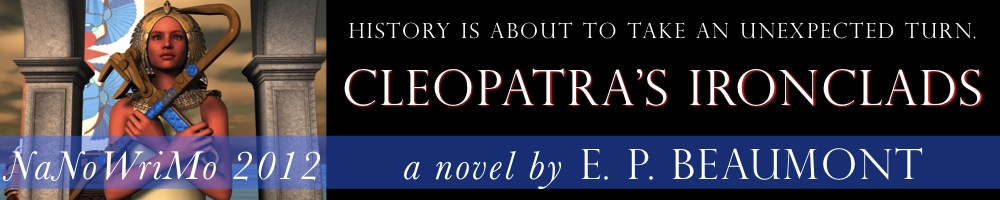
NaNoFeed: by popular request, the large version of the NaNoBanner (click to view at full size)

Image

Posted in Uncategorized | Leave a comment

Six Sentence Sunday, 4 November 2012 (Cleopatra’s Ironclads)

The censorious didn’t care for the rites of the god of wine, but he was the protector of the whole dynasty: the god of frenzy and change, the deity of chance. No army moved without proper rations of wine and that the Great Alexander had understood, so his would-be pupils the Romans might take note as well. And if they mocked at the rites in which all took part, the men and the women, nobles and commoners, dressed counter to their roles in life, the men in women’s vestments and contrariwise, well, it was a great lesson, that life was full of strange reversals…

… As sentient laundry might well be thinking, she thought. From Queen to walking bedroll. The necklace of state dug into her collarbones and breasts, and she’d feel the bruises the next morning, if she should live so long. But it was necessary to be dressed for the part, so at the last safe way-station on her secret journey, she had dressed in her robes of state and the jeweled vulture headdress… though not the ceremonial wig, because that would be far too heavy, and as it was the headdress was only tucked in place by the bedclothes wrapped about her head like the heavy cloak and veil of the desert tribeswomen.

Posted in NaNoWriMo, Writing | Tagged , , , | 3 Comments

NaNoFeed: my novel banner

Posted in Uncategorized | 2 Comments