Writer Tech (Technique): Lev Mirov on self-care, artistic practice, music, and the writerly zone

Edited version of chat interview on Friday, March 20, 2015 9:45 PM

EPB: The first question, which I struggle with: what is the balance, for you, between artistic production and self-care? How has it changed over the years?

LM: Well when I was in high school I stayed up till 4AM working on collaborative projects with friends on the west coast almost every night, often at my computer 16+ hours a day because I was homeschooled.
Those are actually TERRIBLE working conditions. These days, my output is much, much slower but a much higher quality.

EPB: How long are your work bouts? What postures do you work in (seated, recumbent, standing)?

LM: I sit, either at my desk with its ergonomic keyboard, or with a small laptop if I am out (or occasionally reclining in bed), and I woke for no more than an hour before getting up, if that long. I tend to work in micro-bursts of mono-focus, 10 or 15 minutes of writing before I stop typing briefly. If I’m on a roll and the muse is relentless, I take 3-5 minute typing/attention breaks every 15-20 minutes.
I often work about a total of 1-2 hours over the course of an afternoon and evening in small doses.

EPB: What kind of signals from your body tell you to take a break? Do you have any particular practice for checking in with yourself? (disclosure: I am pretty terrible about this, even after injury AND practice as a bodyworker.)

LM: When the muse is damned insistent, or I’m under an external deadline, I often rely on a pomodoro timer app that allows me to set my own intervals, and force myself to stop if the timer goes off to take a break. It can also help me avoid the temptation to read twitter instead of write.
The rest of the time, my body is pretty annoying, I have a pain condition that gets worse if I stay slouched at the computer, so my body is pretty noisy about wanting me to get up, stretch my hands, etc. I’ve used browser extensions that tell you to stretch every 30 minutes before, but I tend to ignore those if the timing is inconvenient. My wife also can’t really get up that often because she has an acute knee injury right now, so I let her requests for things serve as reminders to move around physically. And my cats. If my cats are getting up to trouble, if I’m getting up anyway I’m going to refill my water and check in to make sure I’m not hungry and that sort of thing.

EPB: Tell me about your ideal workspace (and equipment).

LM: Ideally for me, my workspace has a full-sized monitor, a full-sized ergonomic keyboard and a mouse with a middle-clicker scroll, a very high padded chair (I am short) and, this is the crucial stuff for me: a place to put my feet up under the desk, and a heating pad. My muscles get sore very fast, and sitting actively bothers my sciatica, and a heating pad decreases my pain a lot. I’m also sensitive to sound and light, so a pair of over-the-ear headphones are necessary for me.
Out in non-ideal environments, at bare minimum I have to work with a comfortable chair, a full-sized keyboard, and headphones. I have made a rule that even if I want to I should avoid writing without a full-sized keyboard as much as possible, though I break my own rule sometimes and write on the touchscreen on my phone on the train.

EPB: oh wow. I have not mastered that. I only manage it with lots of misspellings for texts.
What other ways do you deal with non-ideal work spaces?

LM: If sound and light are really bothersome, I listen to dubstep or binaural beats and Gregorian chant, both of which drown out outside noises. I sometimes carry a small mouse to use when writing out of the house. I also designate low-attention writing tasks I can do if I’m tired or in pain — which means things like finding non-editing tasks to do, or world-building/brainstorming that doesn’t rely on getting it “right” the first time to keep going.

EPB: We have very similar taste in writing music! Lots of dubstep on my NaNo 2014 playlist. 🙂
and I have listened to Gregorian chant for a long time.

I remember  Gertrude Stein’s Making of Americans_ aloud. Literally felt my chest open up and resonate–“like I am a cathedral” was exactly how I felt – vast, full of music, stony and ancient. No drugs, just voice.

LM:
Somatic emotional resonance is so powerful.

EPB:  Following the example of my buddy Devin Harnois, I started putting together novel playlists.
for each project. I had my music/graphics/IT consultant curate one for NaNo 2014.

LM: Do you know about the website 8tracks.com ?

EPB: Yes! One of the fans of [my co-author] Vera’s big fanfic epic put together playlists for each of the main characters. 🙂
Here’s the playlist for my NaNo 2014 projects (on youtube):https://www.youtube.com/watch?v=kdComTp7KsA&list=PLBy6Vfa64gjVapNcn24LkfbgdN4_1THi2

LM: I use 8tracks to curate writing playlists, as well as character studies. You can follow me if you like   http://8tracks.com/thelionmachine

EPB: So cool!I describe music to my colleagues as “writer’s whiskey, real deal, no hangover & reuseable.”

LM:
It’s the truth. I need to update it, some tracks got mixed up or missing, but a character study you will probably like is here: http://8tracks.com/thelionmachine/the-hound-of-heaven

EPB: oh wow!

LM: It’s for Hugh, my pet immortal crusader, who has to take a back seat while I write a different novel.

EPB: Now I have even more things to listen to!

LM: 8tracks is a never-ending “listen to all the things” adventure.

EPB: Are there any rituals (aside from music and workspace) that you use to get into writing flow?

LM: Sometimes turning on a work-timer can be a ritual, if nothing else it forces me to stop dragging my feet and actually stare at the document window until words come.
The other, terribly unromantic ritual, is I put writing submission deadlines in my calendar and every time I get up to start the day I stare at the deadlines that are coming up next and try to figure out what will serve the thing next approaching, and set up all my notes and outlines and so on AS IF I am going to write that thing today, whether I actually do or not. Often I work on something totally unrelated but it is mostly because I have to come up with reasons not to work on the thing I planned, the productive procrastination model.

EPB: Yes! I do that too! It’s a way to fool the brain.

LM: I apparently have some deep knee-jerk-y un-desire to be published because I keep working on projects while blowing past deadlines for awesome calls for stories.

EPB: What advice would you give to young writers (or young Yourself if you could get in the time machine): about artistic practice, about self-care?

LM: Marathons are for emergencies. They are a bad habitual practice, and they hurt you.
It is more fun, and more productive, to plan to work in the smallest efficient dose at a go; 10 minutes of really dedicated typing every hour is better for your body than trying to marathon a huge number of words in an hour every day.I think writers psyche themselves out about writing by being slavish victims of the muse; either they must write, whether the muse comes or not, even if words are painful to produce and not in a good way, or, if the muse comes, it is a torrential waterfall they must capture before she goes again. If you show up to do the work, and give yourself a really small amount of time to work, work will happen. There’s this concept in productivity studies called resistance and everyone agrees, to overcome resistance you make your goal so small you no longer feel resistance — write 10 minutes, or 100 words, or whatever — and this concept actually works great for sustainable writing, too. Breaking the act of writing into small chunks isn’t romantic, and it’s harder to get swept away into the world for hours at a time, but it also hurts much, much less in terms of repetitive stress.

EPB: I remind people that the original marathon killed the person who did it. 😦

LM: YES. I used to be strapped to a chair all hours of the day and night, and I am 27 and my body now hates me for those previous bad decisions. Young writers do not want to be me.

EPB: zomg… this year, I will be twice 27.

LM: I won’t tell

EPB: And I have done some grievous things to myself, but had the great genetic good fortune to inherit my grandfather’s Hero of Labor constitution. Enormous endurance.

LM: My brother compares me to a dwarf. My constitution is enormous, I can keep going through just about anything, but, alas, heroic endurance is required for ordinary life

EPB: Yes. The writing life is a long campaign, and we have to be wily guerrillas.

LM: I have a rare genetic disorder where all the soft tissue in my body is extra-elastic, and joints do not stay in place and dislocate on a daily (on bad days, hourly) basis.
I want to be creating a long time, so I have to take care of myself now, once my fingers start to dislocate they will never stop.

EPB: Yes. That’s an unmistakable signal.
Over the years, I noticed that my colleagues who either had disabilities or who were physically restless (that’s me) ended up having fewer repetitive stress injuries on average. Artists have a tendency to obsession–I think it comes with the territory–and it’s so easy to overdo, if something doesn’t tell you otherwise. Repetitive stress is really insidious.

LM: It’s why I tend to be the lone militant messenger of the “take breaks and be kind to your body & brain” army. I needed permission, when I was young, to stop while I was ahead, and nobody gave it to me.
younger, I should say.

EPB: When I was programming, I could lose hours at a time. i started drinking water so I’d have to take restroom breaks.
and I built myself a standing workstation — since I couldn’t get standard seated stuff to work for me (I am also short, or at least shorter than the 5’10” “average person” they design furniture for).

LM: One of the interesting things about my disability is my wife also has the same condition, though she hasn’t deteriorated as much as me (her symptoms appeared later in life) and so I am having to teach her how to listen to her body enough to work sustainably, to stop while she’s ahead, etc., because when she was asymptomatic she had been taught to just bulldoze through and get in the zone and spend 4 hours staring at research.
One thesis advisor literally advocated a method of strapping oneself into the chair with a seatbelt and not getting up until the day’s research had been finished and written on!! It seemed so harmless to him to suggest the work is the most important thing, but of course without bodies we can’t do the work, at least until our consciousness can be downloaded into a program that will execute research automatically in the background of a great virtual reality.

EPB: Graduate school has this sweatshop mentality…

LM: It’s terrible for people, and I loved it.

EPB: There is such a fine line between creativity and addiction… or rather, an extensive overlap.

LM: I definitely feel I write, and have written for such a significant portion of my life, because there’s something of a compulsion to it.
There’s a fabulous book called The Midnight Disease about the connection between psychiatric disorders, brains, and the urge to writing, which is full of food for thought.

EPB: I think I’ve heard of this book…

LM: The author is a psychiatrist who had a post-partem mental breakdown with hypergraphia as one of its features.
So it’s written with great sympathy. But not romanticism. I read it in college, during a period where my compulsion to write was keeping me alive (as in: I can’t kill myself, I haven’t finished [long writing project]) which may influence my feelings about it.

EPB: Yes. Sometimes it helps to find an outside anchor (yes, someone else has felt this, it’s real).
I’ve wondered a lot about the similarities between the immersion of reading and of writing.

LM: I have always found writing more immersive, personally, but I think it has to do with what and how I write.
Actually the two pieces that I stayed alive for I never bothered to finish. I do’t think I even could, now. I wrote an epic poem cycle and a Robin Hood retelling set in the Anarchy. I’ve never even re-read either, they were such products of the space where I needed huge, absorbing research-driven pieces to keep myself afloat. In a round-about way the novel became my undergraduate thesis, which was all about the 12th century.

EPB: I think a lot about the “false trails,” but really the undergirding, the architecture, the bones-not-seen of our ruling projects.
My own graduate research went back to age seven. I wanted to understand the shape of the universe.

LM: …what a question to drive you.
I can’t imagine that answer coming out of anything other than the context of a whole life.

EPB: Literally I wanted to understand everything. So by age 17 I wanted to be a systematic philosopher. By 27 I had moderated that to mathematical cosmologist.
My great act of faith is that it’s all one piece. Novelist is as close as I have ever come to my grand ambition.

LM: As a medievalist, the idea of being a systematic philosopher seems so logical to me, but my idea is still of philosophy and her sister theology as “queen of the sciences” even though that’s not my religious worldview.

EPB: Mathematics taught me to read for structure at multiple levels at once. It opened the doors of the mind to poetry, and later to the structure of novels.

LM: I sadly was not taught mathematics in a comprehensible way, it was classical music and poetry that taught me how to do math.

EPB: Mathematics is so poorly taught in this country that I cannot but believe it’s by design.
I studied both logic and martial arts to be able to defend myself with elegance and economy.

LM: I wonder, sometimes. Though in my case it was a flaw of the teachers; my parents were not equipped to teach me algebra and never let me move on to anything else when I was failing.

EPB: I hated algebra.

LM: I did fine when I got to college.

EPB: It was geometry that was the revelation.
Then logic. After a while I could come back to algebra and realize that it was a series of proofs about numbers and their relations.

LM: One of my dear little mental things is that I have a time-traveling architect who writes mathematical spells for traveling through the universe in 3-dimensional space as building schematics.
I should be going to bed, alas. The problem with interesting conversations is I want them to go on forever.

EPB: Same here! Take care of yourself. 🙂

Posted in Interviews, Writer Interview, Writing | Tagged , , , | 2 Comments

Writer Tech: cheap and easy skidproof work surfaces

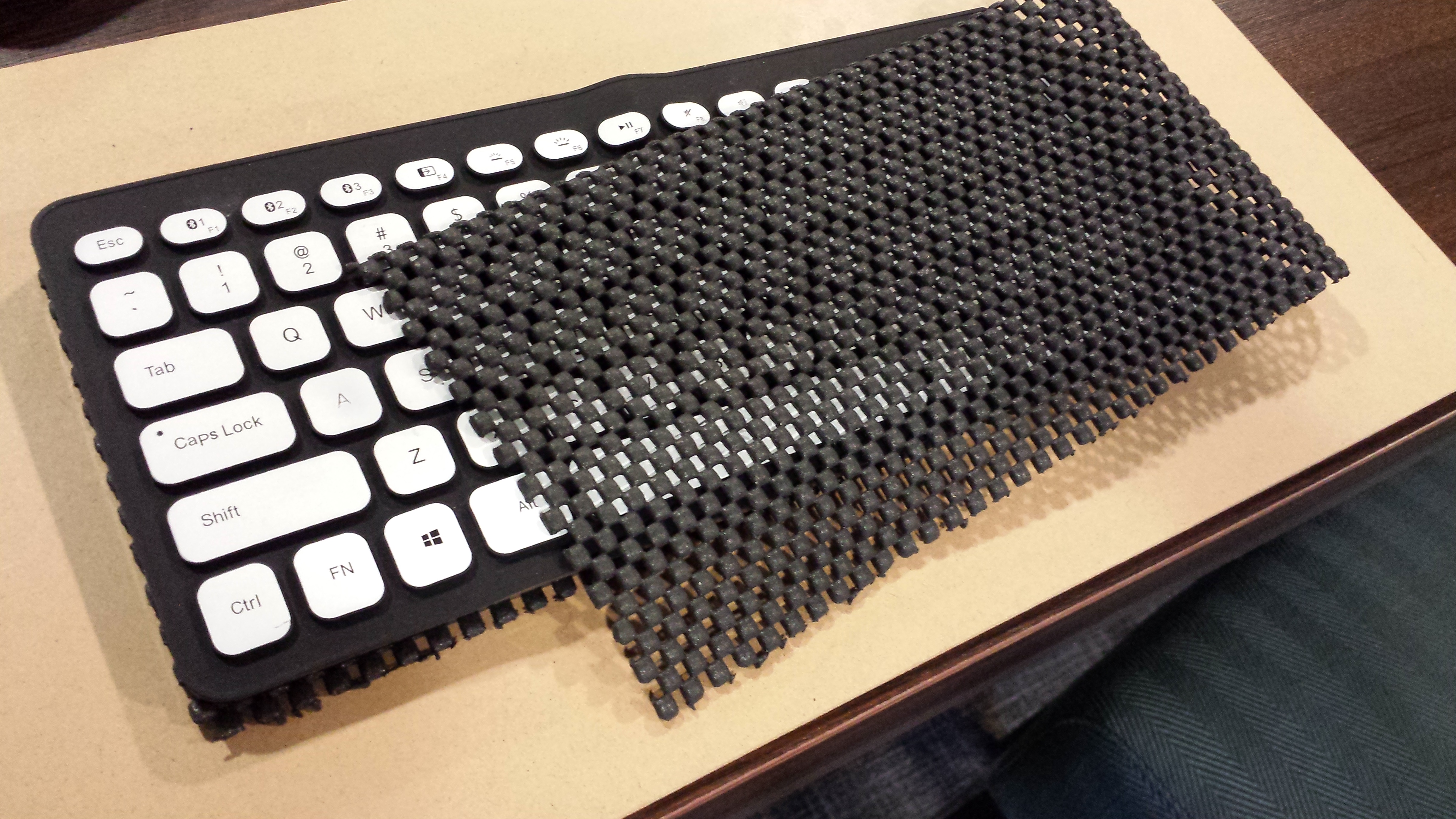
20150307_135527Once upon a time, I had a cool folding keyboard that slid off my lap and never folded up as nicely again. So when I bought the current generation of cool electronics, I said: never again!

Here’s the raw material for one solution to the problem: skidproof shelf liner (photo of display from downtown Minneapolis Target store).

For your reference, here are ergonomic work station recommendations from USA (Occupational Safety and Health Administration).

wpid-20150223_160020.jpgTo create a really low-tech all-in-one phone/tablet stand and skidproof lap desk: cut lengths of shelf liner the same depth as your keyboard and twice as long. (This doubles as a layer of shock absorber when carrying the keyboard). 

If you want more stability for your tablet/phone, use longer/wider cut of shelf liner.

I carry one strip for tablet/phone stand and a separate one for lap desk. This enables me to separate phone and keyboard to create an ergonomic work station for optimal work in sitting, standing, and recumbent position.

image

Photo credit: Brian Zárate

When working in recumbent position: use any flat rigid surface (below we are using a small piece of Masonite) as work surface. Prop against a pillow in your lap to work at any desired angle. Place skidproof shelf liner to keep keyboard in place on the work surface.

Roll up a second strip to create a phone/tablet stand. This is pure analog and can be adjusted to any desired viewing angle!

wpid-evernote-snapshot-20150223-150204.jpg.jpeg

Photo credit: Brian Zárate

What’s not visible in this picture: I usually work recumbent with a pillow under my knees, and a second pillow as a foot rest (to keep ankles in neutral position.

Posted in Writing | Tagged , | Leave a comment

Genre Trouble: (Mis) Use of the Muse

This post is dedicated to my colleague E. E. Ottoman, who raised the question in this Twitter conversation. The glory of Twitter is that you can have conversations with friends and colleagues, then come back to them later.

This exchange began with a retweeted comment from Sasha Devlin about writers invoking the idea of the Muse, and merely being a conduit for the story and characters, in answer to charges of racism. Ottoman added transphobia to the list, and I chimed in that the “Muse excuse” is as repellent as the “swept away” conceit for bad behavior of all kinds. (See also “drunk at the time.”)

Artistic work, creative work of any kind (including problem-solving in the sciences), has a conscious and an unconscious component. My mentors were fond of cooking and farming metaphors: you plant the seed, but it grows on its own; you mix the ingredients of the cake, apply heat — but the process of glop-becoming-cake is independent of your effort. (In fact, if it’s a soufflé, you’re well advised not to stomp around while it’s in process.)

A part of the mind that chews on problems when we’re not consciously attending to them, even when we’re asleep. I’ve had coherent dreams about problems I was chewing on in real life, as various as Russian grammar (in a dream about crocodiles infesting cars on the Paris Metro) and coordinate description of conic sections. More than once I’ve turned my back on a a problem, gone for a walk, and returned to find it solved. And even the most casual practitioner of mindfulness has caught themselves thinking thoughts they had no idea were going through their head, whether it’s the enumeration of the grocery list or the daydream/nightmare of what could go wrong (next).

Theater has a lot of lessons for us writer-types. I was mentored by a writer/performer who trained extensively in the Method, which is nothing less than a protocol for possession. We learn the sensory experiences of our characters and put them on while drawing on our own experiences and emotions. Actors, like writers, apply both emotion and intellect to their artistic work, and run some of the same spiritual and psychological risks: to believe (too much) in our own hype, to be taken over by ideas not our own, to invite Presences into our head-space who may not act as we wish.  We must balance emotion, and formal rigor, which includes intellectual awareness, historic context. Conscientious actors do TONS of research for their roles.

Writers do their first apprenticeship as readers. We absorb the forms we love; novel-readers eat novels and turn them into plot-bones; poets drink verse forms and rhythms, learning them as a jazz musician learns standards. I’ve joked on more than one occasion that writers are vectors for stories. The “muse” invoked above is the product of our decades of reading. In the course of our conversation on Twitter, Ottoman expressed irritation at the notion that all you had to do to be “marketable” was to be sufficiently “inspired.” Now, “what sells’ is a function of the industry’s search for The Next Sure Thing, but to some extent those “inspired” writers replicating old tropes are like well-rehearsed actors; they have learned those forms, internalized them so that (for better or worse) they come as naturally as breathing.

Of course, the sure thing is a chimera. Publishing, like all artistic ventures, is a crapshoot. The media love “overnight success” stories. The reality: decades of discipline, training, practice, then lucky break. Those decades of practice, for a writer, include our reading.

Doctors take an oath to “first do no harm.” We underestimate our power as writers if we don’t have a similar resolution. The “Mere Entertainer” pose does not take the role of artist/writer seriously. I live in fear of Getting It Wrong, and inevitably do so, as a fallible human being. I am so glad that none of my teenage efforts Full of Fail are published – not because of vanity, but out of desire not to hurt readers. I believe it is our ethical and intellectual duty to examine critically the ideas we receive from the culture, to listen to other voices, and strive to do no harm.

I know that Fail lurks in my current work. My culture is itself Full of Fail (racism, sexism, *ism) and I am a product of it. I grew up inside it. I’m constantly finding its thoughts stuck to the inside of my head, otherwise known as the Flypaper Theory of Internalized Fail.

But that doesn’t mean that I’m excused from paying attention, or that the content of my work is outside my conscious will.

Posted in Writing | Tagged , | Leave a comment

From Fan Fiction to Original Fiction: Plotting is Pantsing (Excerpt)

Concept cover by Glass Knife Press.

Concept cover by Glass Knife Press.

All writing is improvisation.

This cannot be repeated often enough. As a fanfic writer I alternate between writing stuff that just randomly popped up to tug my sleeve, and writing to prompts that appeal to me. There’s a whole very active scene in fandom where you propose a prompt and people write to it.

You get multiple stories, all very different, from the same prompt.

A plot is an elaborate prompt. Sometimes you build that prompt in great detail, with timelines of events and who’s where when. Oddly enough, that structure gives huge scope for improvisation; you have safe knowledge of the background, the stage set as it were, so there are things already in place that you don’t have to worry about while you let the characters come into the room and interact with each other. You already know the details so you don’t have to fuss with them.

Other writers like to just jump in and write into the darkness, having only the faintest idea where they’re headed, except in the sense that X, Y, or Z juicy event is waiting for them.

Sometimes all you have is a draft final scene you’re aiming for. That distant beacon gives your efforts some forward momentum, but the stuff that comes up as characters interact, make decisions, do things, will sometimes carry you wildly off course from what you thought was your real destination.

That’s fine. You can throw stuff out.

***

Excerpt from forthcoming From Fanfiction to Original Fiction (Vera Rozalsky with E. P. Beaumont)

Posted in Writing | Tagged , , , | 2 Comments

Weekend Writing Warriors: Sunday 5 April 2015 (WIP: Ship’s Heart)

Blue is the color of life, Mavra had said.

As they arrived in the Karis system, Jehen watched the steady blue glow at the planet’s curve. Space shaded from lightless black, the color of Nothing near absolute zero, to the shade still called midnight by old tradition, to purplish-blue, then  flared into unbearably bright ultramarine. The edge was lost in a blaze of blue-white at the horizon where the sunlight of Karis caught it.

As they moved in closer, that light showed floating layers of cloud, the atmospheric system that not only supported life but made it burgeon. Those great spirals were made of the tops of the legendary cloud-towers of Karis.

As the Ship bore them ever closer to their destination, Vlada Ship’s-Heart showed them the picture through the full spectrum, zoomed in to show electric and gamma-ray discharge into space from the mighty storm-whorls over the True Ocean of Karis.
All of the names they had for blue, all of them came from the Original World.

***

From Part II, in which Jehen and her siblings are sent to the starship academy.

Weekend Writing Warriors offers a selection of eight-sentence excerpts from many different writers. For the full selection, see here.

Posted in Writing | Tagged , , , , | 2 Comments

Goals, midweek check-in

This weekend I spent at work on my writing website (look at the lovely new menus above this post! *preens*) At time of writing, there are over 450 posts on this blog, fortunately well tagged. Nonethless, it took some time to square my sense of how things hung together against a workable site map.

By “some time” I mean two 16-hour days, back to back. Behind-the-scenes work is really addictive, I’ll just say.

As a result, neck and shoulders went on strike, so self-care took precedence. And since I chat about this topic a lot with my more self-aware Twitter pals, I figured it would be really bad for me to rack myself up so badly that I couldn’t even tweet about what a huge hypocrite I was.

So we’ve put off the reviews until next week (there’s a pile) and interview editing is still in process.

Meanwhile, in writing and publishing news:

  • I’m doing Camp NaNoWriMo with a select company. I’ll be taking up Ship’s Heart once more, as well as character interviews for the trilogy of which it is a part.
  • I’m also putting a tentative toe into the waters of promoting my fiction work. If you review or blog about books and would like to get a review copy, here’s the Fiction e-ARC request link at Glass Knife Press.
  • If you would be interested in receiving an e-ARC of my upcoming nonfiction work with Vera Rozalsky, From Fanfiction to Original Fiction, e-ARCs will be available starting June 15. Here’s the Nonfiction e-ARC request link.
Posted in Goals, Writing | Tagged , , , , | Leave a comment

Weekend Writing Warriors: Sunday 29 March 2015 (WIP: Ship’s Heart)

Behind the crew entered a woman whose ordinary brown skin was threaded with scars on one half of her face, and on the other, gave way to glass and ceramic fittings and an unblinking eye that wasn’t anything natural. Gasps of admiration went up from the adult onlookers, and Yasmin was hoisted to her gene-father’s broad shoulder, among a forest of the other children. They didn’t wave to each other, but all turned the same way to look upon the visitor.

“Oh, those are gorgeous repairs,” Altair said. “They kept the Treaty, oh they did.”

The visitor smiled with the human side of her face. The glass-and-ceramic mask on the other side glowed in its spiderweb of leads. Tears shone in the human eye, as the children held out their arms to her, and the adults carried the final chorus of the Song of Fortunate Return: “Mavra Fix-all, welcome home.”

***

From my work-in-progress novel Ship’s Heart, the prequel to Inside the Jump. Yasmin, Jehen’s younger sister, is five years old. Mavra Fix-all is a starship captain returning home after the wreck of her ship.

Weekend Writing Warriors offers a selection of eight-sentence excerpts from many different writers. For the full selection, see here.

Posted in Writing | Tagged , , , , | 5 Comments

Love in the Time of Starships: A Matter of Scale, or Intimate Epics (Silvia Moreno-Garcia, Margrét Helgadóttir)

  • Margrét Helgadóttir. The Stars Seem So Far Away
  • Silvia Moreno-Garcia. Signal to Noise

Note: I purchased my own copy of Signal to Noise, and received a review copy of The Stars Seem So Far Away from the publisher, Fox Spirit Books.

***

Stories are the original magical technology, and the present review is a foredoomed attempt to reverse-engineer one face of the enchantment: the apparent size of the space and time that live between the covers. Continue reading

Posted in Book Review | Tagged , , | 3 Comments

From Fan Fiction to Original Fiction: On Backstory (Excerpt)

Concept cover by Glass Knife Press.

Concept cover by Glass Knife Press.

Ah, backstory.

Everybody hates the info-dump, right? Writers hate how much their readers don’t know, and try to spare them the perils of ignorance; readers hate how much stuff the writer is feeding them (Why are you force-feeding me this set of diplomatic correspondence? I did not want a geology textbook for breakfast! What’s with this prologue four thousand years before the story starts?)

The beautiful thing about the best fanfic is that it simply takes it all for granted, and only alludes to backstory when it comes up for discussion because of something in present tense.

“Well, of course you don’t need to tell all that. Everybody reading this is a fan.”

Au contraire, my friends—I have read awesome fanfic in other fandoms in which I have zero clue about the canon material. Why just the other day my buddy Truant sent me to read a fanfic called Persephone on Archive of Our Own, based in the universe of the film Prometheus. I didn’t know anything at all about the film, but the story read very well nonetheless, as a creepy and yet weirdly moving relationship between a robot and a human. (One of the tags read “Is it het if he’s a robot?”) To me, it was simply an effective and elegant science-fiction short story.

Great fanfic in alien fandoms is simply great fiction, to the uninitiated reader.

***

Excerpt from forthcoming From Fanfiction to Original Fiction (Vera Rozalsky with E. P. Beaumont)

Posted in Writing | Tagged , , , | Leave a comment

Weekend Writing Warriors: Sunday 22 March 2015 (WIP: Ship’s Heart)

Yasmin listened, putting her hands up to feel the bells in her tightly twisted braids. They pulled pleasantly on her scalp; she wiggled her ears and they jingled faintly. Jehen looked at her sidelong; even though she was a year older, she hadn’t mastered that trick. The adults’ faces were intent and glowing; Yasmin understood only some of the words.

She had seen the pictures, how their own world was a tiny ball, and outside it ranged the whole universe, which was mostly empty. How Ships traveled from place to place by Jumps, for otherwise they might be thousands of years in transit.

The Journey-ships from the Original World had been like that, for it was only by accident that they discovered and survived the Jump. And then by great luck, they had found Karis, Mother of Worlds, and from there, humans had spread to the other systems that comprised the Inhabited Worlds.

***

From my work-in-progress novel Ship’s Heart, the prequel to Inside the Jump. Yasmin, Jehen’s younger sister, is five years old and is listening to the call-and-response between the Dome’s ground control and an incoming supply ship.

Weekend Writing Warriors offers a selection of eight-sentence excerpts from many different writers. For the full selection, see here.

Posted in Writing | Tagged , , , , | 8 Comments